The development of logistics infrastructure—encompassing warehouses, distribution centers, transport, and increasingly digital infrastructure—has become one of the key factors determining the competitiveness of modern economies. In the context of global supply chains, rapidly growing e-commerce, and the nearshoring trend, the efficiency of logistics systems directly translates into economic growth, levels of foreign investment, and overall business productivity.
This relationship is clearly reflected in the data. In recent years, Poland has maintained relatively strong economic growth, at around 3–3.5% annually—well above the average for Western Europe. At the same time, the logistics sector has been expanding rapidly: total modern warehouse stock increased from approximately 20 million sqm in 2019 to over 35 million sqm in 2025. This nearly 80% expansion within just a few years illustrates both the scale of transformation and the growing importance of logistics as a key driver of economic growth.
While the quantitative growth of the sector is significant, competitive advantage is increasingly determined by the quality of infrastructure. Modern logistics facilities are evolving into advanced operational hubs, incorporating automation, digital solutions, and integrated supply chain management systems. Urban logistics and flexible formats are also gaining importance, enabling efficient last-mile delivery and shorter delivery times.
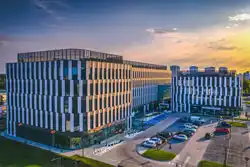
A strong example of this transformation is DL Invest Group, which consistently develops both large-scale big-box logistics parks and more flexible formats tailored to evolving market needs. In the large-scale segment, the company delivers projects in key locations across Poland, providing infrastructure for logistics operators and manufacturing companies operating at a European scale. Importantly, DL Invest Group operates as a long-term investor, following a “build and hold” strategy—developing assets with the intention of retaining them within its portfolio and managing them over the long term. In a rapidly growing market, this approach supports sector stability, higher quality standards, and long-term tenant relationships.
At the same time, the company is expanding its portfolio of smaller business units (SBU), which respond to the growing importance of e-commerce and urban distribution. These formats enhance operational flexibility and allow infrastructure to better match local market needs. Combined with a long-term investment approach, this results in the creation of durable, high-quality infrastructure that becomes an integral part of modern urban and regional systems.
Another important direction—also visible in DL Invest Group’s strategy—is the integration of logistics with digital infrastructure. As data and automation become increasingly critical, operational efficiency depends not only on location and scale but also on the ability to process information in real time. Logistics is therefore no longer just about the physical movement of goods; it is becoming part of a broader technological ecosystem.
Compared to Western Europe, Poland remains one of the most dynamic logistics markets while steadily reaching maturity. Rising operating costs in countries such as Germany or the Netherlands are driving a shift of investments toward Central and Eastern Europe. Thanks to its scale, location, and well-developed infrastructure, Poland is one of the main beneficiaries of this trend, strengthening its position as a key logistics hub for the entire European Union.
The importance of logistics infrastructure for economic competitiveness is best illustrated by its impact on several key areas:
As a result, logistics can no longer be perceived merely as an operational backbone of the economy. It has evolved into one of its strategic pillars—comparable in importance to energy or digital infrastructure. The direction of the sector’s development increasingly indicates that sustainable competitive advantage will be determined not by scale alone, but by the quality of assets, the level of technological integration, and a disciplined, long-term investment approach, as exemplified by companies such as DL Invest Group.